Wednesday, October 29, 2008

Day of Prayer for Creation Care

By Chris Olson, Outreach Coordinator

Throughout my college experience I learned about the problems facing the environment on a daily basis, but seldom heard about the faith-based call to be stewards of the environment. As I was considering my post-graduation options last winter, one of the reasons a job at Earth Ministry was so appealing to me was that it was a way to integrate the environmental education I received with the call to care for creation that I knew was an important part of my faith. And yet, I rarely heard about this synergistic connection in my college classes or faith community.


Working at Earth Ministry has already been an incredible learning experience. I have been motivated to reach out to my friends still in college who long for developing a clear connection between the role of faith communities in addressing environmental issues. A task that can seem daunting and hopeless. It is the unique aspect of the faith perspective that brings hope to such overwhelming issues and inspires youth and students to become involved in creation care efforts.


By mobilizing college students, a new energy and imagination can be brought to the work of building positive change both locally and globally. That is why I'm so excited that today is the National Day of Prayer for Creation Care! Doesn't that have a nice ring to it? Across the country, people will be joining together to lift up their prayers about environmental concerns and global issues. The brainchild of this national movment is Renewal: Students Caring for Creation. While Renewal's mission is focused on mobilizing college students to care for God's creation, that doesn't mean that the rest of us college graduates can't participate!

Please, on this national day of prayer, lift up your voice and stand in hope with many others for the beautiful creation of which we are a part.

If you would like more information about The Day of Prayer for Creation Care please visit: http://www.renewingcreation.org/

Wednesday, October 15, 2008

Blog 101

Since many of our blog readers may not be as familiar with how the bloggosphere works, for today's post, I'd like to offer a little tutorial on how to make the best of your blogging experience.

Right-side navigation
  • Contributors - this section includes links to pictures and short profiles (where available) of all the contributors to the Earth Ministry blog. Contributors include staff members and interns.
  • Receive Earth Ministry's Blog in Your Email Inbox! - by submitting your email address in this box, you can receive the newest blog as an email at the end of the day on which the blog was posted. This is a great feature if you don't want to keep checking the blog manually but want to keep up to date on the latest reflections at Earth Ministry!
  • Blog Archive - I'm sure most of you know that the newest posts are at the top of the page with older posts below it in order of appearance. But what you may not know is that you can view all of our older posts, organized by date, in this section.
  • Labels - The Earth Ministry bloggers all make painstaking efforts to label our posts with keywords so that if you can read by subject matter or author. Want to see all the blogs on the topic of climate change? Click on that keyword "climate change" and you'll see all of them in one place. Or want to read all the blogs by Beth Anderson? Click on "Beth" and there they will be. Now isn't that a great feature?!

Inside the Post

At the bottom of every blog post, there are a series of buttons. Let's get to know them now.

Comments! - The ability to post comments and interact with the thoughts and ideas of bloggers is what makes the blogosphere go round. We would love to hear more from our readers. Tell us what you like. Tell us what you think. Do our blog posts move you or cause you to reminisce? If so, let us know!

Email Post to a Friend - Ever feel so inspired by a blog post that you want to share it with your friends? All you have to do is click the envelope icon.

That concludes our tutorial, Blog 101. Please let us know if there is a topic you'd like addressed in the blog or just let us know what you think at all. Happy blog reading!

Tuesday, October 14, 2008

Get Outside, Rain or Shine

A couple weeks ago I started my fall courses at Seattle University’s School of Theology & Ministry. Back together after a months-long break, classmates can be heard asking one another, “What did you do this summer?”

For many of us, the answer includes activities like family picnics, hiking, swimming, outdoor festivals or concerts, and generally lots of time soaking up sun and fresh air.

The highlight of my summer was a four-day backpacking trip in the Glacier Peak Wilderness—we walked to Spider Meadow, up and over Spider Gap, down to Lyman Lakes, up and down over Cloudy, Suiattle, and Buck Creek Passes, and finally down the Buck Creek valley to the old mining town of Trinity.

You can tell from the photos that we enjoyed AMAZING weather during this trip—all sun and stunning views and not a drop of the wet stuff. In weather like that, one could hardly imagine spending time indoors.

Fast forward to the October—the beginning of the school year and the start of the rainy season in the Pacific Northwest. Not only is the weather unsettled and the sky dominated by clouds but the sun rises much later and sets much earlier, leaving little light outside standard workday hours.

Lakes no longer invite swimmers to refresh themselves in their clear waters; the mountains are hidden behind a veil of mist, warning potential hikers to think twice about venturing onto the trails.

During these rainy months I am torn between gearing up and continuing to spend time outside or taking the path of least resistance…straight to my couch.

Yesterday I suited up in raingear, packed my school books in plastic bags, and headed to class on my bike. Once I was soaked to the bone, I made peace with the weather—the rain and I were able to coexist rather nicely on the 35-minute ride.

And although it would be hard for me to speak about the rainy bike ride with the same affection I had for the sunny backpacking trip, in both circumstances I was able to connect with the natural world. That connection is my motivation to get outside, rain or shine.

Friday, October 10, 2008

Celebration of St. Francis Sermon Contest!

On Saturday, October 4th, Earth Ministry held its 16th Annual Celebration of St. Francis. This year's celebration featured a Creation-Care Sermon Contest. We received neraly 50 sermons from members in 13 states. We chose six finalists to present their sermons at our event on the Feast of St. Francis:
  • Annette Andrews-Lux, Freeland, WA
  • Tom Walker, Clinton, WA
  • Sherry Golden, Flagstaff, AZ
  • Rev. Mary Brown, North Bend, WA
  • Rev. Gerry Porter, Kingston, WA
  • Sister Mimi Maloney, Olympia, WA

At the Celebration we also honored four new Greening Congregations:

  • First Presbyterian Church, Port Townsend, WA
  • Woodland Park Presbyterian, Seattle, WA
  • Wesley UMC, Yakima, WA
  • Grace Episcopal, Bainbridge Island, WA

In addition, we were uplifted by creation-themed choral music provided by the choirs of Trinity UMC and Plymouth UCC. It was indeed a celebratory service!

Those gathered chose Sherry Golden as the winner in the lay category and Sister Mimi Maloney was selected as the winner in the clergy/vowed religious category. Congratulations to Sherry, Sister Mimi, and all the finalists. We were blessed and moved by all of your homilies!

A video of each sermon is posted below in the order in which they were given along with the title of the sermon and name of the contestant. Enjoy!

Lay Category


"Renewing the Earth Community" by Annette Andrews-Lux


"Renew a Right Spirit" by Tom Walke
r


"Keeping the Sabbath to Keep the Earth" by Sherry Golden


Clergy/Vowed Religious Category

"Staying Awake" by Rev. Mary Brown


"Abundance: Answering God's Call" by Rev. Gerald Porter


"The Care of Creation as a Moral and Ethical Imperative" by Sister Mimi Maloney


Thank you very much to all who entered the contest and congratulations to the winners!

Advocacy in Times of Change

by Jessie Dye

One voice makes a difference; one vote makes a difference; one letter to the editor or cloth bag changes everything!

Is that naïve? No, in fact recent surveys are confirming what community organizers have known for years: the confident words and visible behavior of one person or a small group of people have an influence far beyond their own sphere.

For example, in a recent note from Annette Frahm of Sage Environmental on energy conservation, she reports:

In a large-scale survey, people ranked the importance of several reasons to
conserve energy. The results, from most to least important:
1) it will help the environment;
2) it will benefit society;
3) it will save me money;
4) other people are doing it.

However, researchers found that the belief that others were conserving correlated twice as highly with reported energy saving efforts as any of the other reasons. A follow-up marketing experiment confirmed these survey findings.

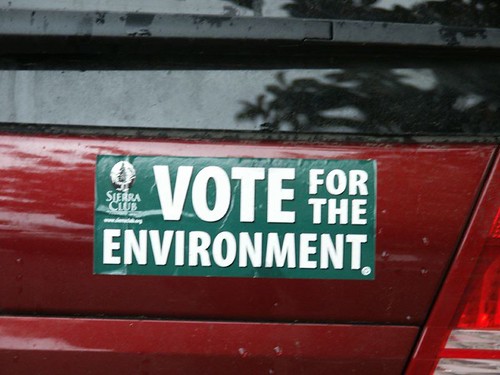
This means your vote, your opinion, your choices make a big difference in influencing the direction of our country, especially during these heated national and local elections. Here are some specific ways you can use your voice for advocacy for God’s Creation:

  • Vote! Especially make sure your children and grandchildren and friends are registered to vote. The deadline in the State of Washington for in-person registration is Saturday, October 18th.

  • Check out the Scorecard of the League of Conservation Voters (http://www.lcv.org/scorecard) to find the record of your elected officials on the environment.

  • Vote all the way down the ballot! In King, Pierce, and Snohomish Counties in Washington, Proposition One is a great bill to help reverse global warming pollution and improve our terrible traffic. But it’s at the end of the ballot! Vote all the way “down ballot” and vote YES on Prop. One.

  • Any chance you have, tell your legislators, your friends, and your colleagues that climate change is the great moral issue of our time and is your top priority for public policy. Explain that protecting Creation matters most to you in this election. Here’s one website that can give you specific tools to do this: http://www.1skywashington.org/

Your voice makes more difference than you can imagine! At Earth Ministry we see the wonderful possibilities for green jobs, clean energy investment, a healthy and secure economy, a renewed quality of life, and a return to respect for the common good. It can be done, and it can be done in time. It is your voice and your vote that will make it happen. The time is now.

(Originally written for the Episcopal Bishop’s Committee on the Environment newsletter)

Wednesday, October 8, 2008

The Place Where We Stand


By Mikaila Gawryn Earth Ministry Outreach Associate

Today for lunch I will eat mashed turnips. Yes, you can indeed mash turnips and they have a wonderful, spicy flavor. I am new to turnip consumption and was reminded of this last night as I pulled the thick imperial purple skin off the plump tuber. My father walked in and immediately said, "Wow, what a great turnip!" (I of course looked up radish twice in my cookbook before remembering that what I actually had was a turnip, and this is after having pulled it from the ground myself!!)

It feels like even one generation ago children grew up more familiar with their food than they do today. My father is not very interested in cooking and I was expecting to explain to my family what beautiful earthy things I had brought home that evening. Yet to my surprise he recognized the vegetable at a glance.

The soil from which I pulled this magnificent bulb is on the Clean Greens farm, run by New Hope Baptist Church. Sara Jean Green, of the Seattle Times writes that Rev. Robert Jeffrey Sr. started the farm with the mission to "bring affordable, organic produce to the poorest families in Seattle's urban core." The project had a rocky start, but after set backs they started bringing in the first harvest last Friday. The volunteer based harvest events are called Clean Greens Harvest Parties. I had the honor of bundling verdant spinach and gathering collard greens the size of prehistoric dinosaur feet.

"The best place for each is where [she] stands."
- Ralph Waldo Emerson


Ralph Waldo Emerson once said "The best place for each is where [she] stands." I believe Emerson is saying that knowing the earth we live on ought to be our personal work. Emerson quoted his life long friend Henry David Thoreau, who expanded upon this point: "I think nothing is to be hoped from you, if this bit of mould under your feet is not sweeter to you to eat than any other in this world, or in any world." Today the soil that Thoreau refers to still yields sweet things for us to eat. Both Thoreau and Emerson understood that a love of the earth directly beneath our feet should be cultivated before we head out into the larger world. What better time to learn this than as a child?

As I walked along the furrows of the Duvall farmland on Friday I felt cold rain from collard greens on my hands and heard birds speaking to one another in surrounding hedges. Clean Green Farm is organic, providing homes for birds and small snakes which keep insects and weeds at bay.

As one of the younger generation I know I lack familiarity with the earth that provides for my air, food, shelter and water. Working at the Clean Greens Farm gave me a taste of the sweetness that comes from knowing this land personally.

In my time at Earth Ministry I have had the opportunity to work on the Caring for All Creation module At the Table. This module provides liturgical, educational and logistical resources to Christian communities interested in learning about why food choices should be sustainable choices if they are rooted in faith. Churches can choose to partner with a local farm or host a sustainable community meal after they learn about food and faith in their worship service.

Through my work I've found that Washington has numerous opportunities for people to learn about this land upon which we stand. Supporting the Clean Greens farm through volunteering is one of those opportunities. What is exciting about the Clean Greens farm is that it is also an opportunity to provide healthy food for people that need it the most. This is exactly where our faith based food choices should lead us.

If your congregation is interested in learning about the connection between food and faith the expanded version of At the Table will be out by the end of this year. But in the meantime you can still be involved! Stay tuned for information about future Clean Greens Harvest Parties on our digest.

Take some time to mash some turnips and if you can, teach a child, or yourself, to recognize the goodness that this earth beneath our feet produces. Perhaps if we do this, there can be hope for us after all.

Sources:
http://seattletimes.nwsource.com/html/localnews/2004474432_newfarmers13m.html

http://eserver.org/thoreau/emerson1.html

Wednesday, October 1, 2008

Celebrating Even if We Stumble to the Finish Line


By Mikaila Gawryn
Earth Ministry Outreach Associate

Congratulations!! We crossed the finish line!! Our Three Month 300 Mile Food Challenge was successfully completed yesterday!! I must say though, my part of the completion was not as successful as I had hoped.

Okay... to be honest I practically fell across the finish line. It was hard!! Eating only local food for three months was more challenging than I could have expected, but even the times that I messed up provided opportunities for learning.

Two years ago University of Washington Professor David Domke addressed members and friends of Earth Ministry at our annual Celebration of St. Francis. I was attending as a volunteer, and I remember standing outside the sanctuary where he was speaking, straightening up brochures and snacks for the reception. From in the lobby I heard him say something that I will never forget. Professor Domke said that in the environmental community all too often "we sacrifice the good on the alter of perfection".

Having spent the last three years in an environmental studies B.A. program I know exactly what he was talking about. In my program I felt like I was practically eating, sleeping and breathing environmental topics. Pollution, extinction and degradation were all around and it was easy to fall into legalistic patterns of control when trying to cope with the impending doom I was reading about.


"All too often we sacrifice the good on the alter of perfection."

- Professor David Domke


Not surprisingly, this legalism can be accompanied by a holier-than-thou attitude, and I know because I had it! I started to believe that if I did everything right I could actually avoid being a part of the degradation of our natural world. This belief is clearly contradicted by the teachings of our faith:

Romans 3:23 says, "There is no difference, for all have sinned and fall short of the Glory of God."

It is also contradicted by the realities of our world. By participating in the systems of contemporary society, we become part of the injustice they bring about.

Unfortunately, I think it is this legalistic and arrogant attitude which keeps many people from getting involved in environmental action. I consider myself a part of the environmental community and I still hate it when someone makes me feel guilty.

Perhaps the greatest contribution the Christian faith community can make to environmental work is the acknowledgment that we are a fallen people. We don't have our act together, we unavoidably participate in the unjust processes in our world that victimize our fellow human beings and God's creation.

Yet, as Professor Domke explained, the inability to be perfect does not mean we should cease striving to do good. Our Three Months 300 Miles food challenge was just that, a challenge. But it was a good experience for me. It taught me to use muscles that I haven't been aware of before. Like the muscle of intentional meal planning that is required when I try to only buy seasonal produce each week. And the scheduling habits necessary for only shopping when the farmers markets are actually open.

Even though our food challenge is over the Earth Ministry staff is still still working to support local organic food. This week we'll be heading out to help bring in the harvest with New Hope Baptist Church! We'll be participating in the Clean Greens Project with a farm located in Duvall Washington. New Hope Baptist church has been working hard all season to bring in the crops that they planted themselves in the spring. If you're interested, please join us and New Hope members for a day of working in the earth and bringing local food to local people who need it.

Clean Greens Harvest Party

Friday, October 3rd, 9AM
Meet at New Hope Baptist Church, 116 21st Ave Seattle WA 98122

or at the farm,
20121 W. Snoqualmie River Rd. NE, Duvall WA 98019
Water will be provided, but please bring food for your lunch.


I hope to see you there!
Mikaila

Monday, September 29, 2008

Space and Time


by Deanna Matzen

I started reading a new book the other day. It's called "The One-Life Solution" by Dr. Henry Cloud. It's not about the environment, but rather about boundaries and work life. So, in a way, it is about the environment -- the emotional, relational, and performance environments we live in every day -- and in another way, it's about the community of people working on behalf of the environment.

Why am I reading this book? Well, I'm going to be candid for a moment. Environmental work is hard work. It's fast-paced like the rest of our society. We see a very urgent need and we are all running after a solution. And, let me tell you, things are busy over here at Earth Ministry and there are days that I know I'm not keeping up.

So as I was reading the book during my lunch break the other day, I was struck by something. First I'll share the text and then I'll comment.

"The issue of boundaries is one of the biggest issues that all of us will face in business and life....The long and the short of it is that time and space --long-depended upon boundaries on work --no longer exist. So, work has become an invader of the rest of life, in time, space, energy, and other ways. Family interaction decreases, and quality of interaction decreases. Other social ties suffer as well. Now people spend hours they used to spend on life together in front of some
kind of screen instead--working....The result of this, and the disappearance of many other
boundaries from our society--such as morals and values that used to contain a lot of destruction and help to integrate our characters--is that more and more we are living in a "structureless" life."

When I read those words I thought, "hmmm...ain't that the truth." Then I reflected on Earth Ministry's attempts to enter and use the world of screens to get our message out. For example, this year we have started a this blog, created a group and cause on Facebook, and sent out more email alerts. When we started our Facebook page, most of the staff had not ventured into the realm of online communities. For me, it was fun to see how many friends I had and to keep up on the daily life of friends far away. But the longer I'm on Facebook, the more I realize that it's just a disconnected use of my time. I don't "see" my friends nor engage in any of the quality conversations that I thrive on...those conversations where we talk about life, faith, politics, the world, our loves and passions, musings and stories.

And when I started to really examine it, I realized that one of the great benefits of Earth Ministry is that we still hold events like the Celebration of St. Francis and Colleague Consultations. These are events where people come together face to face and have those moments of "destruction and help that integrate our characters". When we engage in conversation about morals and values, we break down and deconstruct our ideas and beliefs that act as barriers to integrating our selves as whole people and as whole societies.

In the season of presidential politics, aren't you starving to get your face out of the TV and look at people in real time and space? Or maybe you're tired of talking politics at the water cooler, rehashing everything the media has said on a topic. If this is you, I invite you to engage with Earth Ministry members, board and staff by attending one of our upcoming events. Set some boundaries on work and TV...come have fun with us, learn with us, worship with us, breathe in some fresh hope, engage with us and connect with God through community. In the end, you may find yourself a little more integrated!

Friday, September 26, 2008

Green Jobs & Sustainability this Weekend!


This is one of those weekends where the options for environment-focused activities abound! And according to the current forecast, the weather is planning to cooperate with those of us who enjoy spending as much time as possible outdoors.

First up is 1Sky of Washington’s Green Jobs For All Day of Action on Saturday, September 27. (Earth Ministry is a 1Sky partner organization.) Click on the highlighted text to see a list of specific events in the Puget Sound area. This day of action is meant to highlight the need for building a green economy and to show candidates that this is an important issue for many Americans. Click here to see a video of Van Jones talking about the goals for the Green Jobs Day of Action.

Next on the agenda should be a trip to the Sustainable Ballard festival, held from 11am-5pm both Saturday and Sunday in Ballard Commons Park. There will be stations to sew your own reusable tote bags, apply for your Undriver’s License, learn about reducing home energy use, and much more! Admission is free, so take the bus, ride your bike, or walk to Ballard for a weekend of environmentally-friendly fun.

Tuesday, September 23, 2008

Water Down the Drain


By Chris Olson

A major aspect of my Lutheran Volunteer Corps year deals with forming intentional community around the three tenets of Social Justice, Sustainability, and Community. One of the issues that our house as been talking about is water conservation, specifically around our dishwasher. We didn't expect to have many amenities in our house since so much of the LVC experience is about simplified living, but were surprised to find a well furnished home when we arrived (thanks to the generous folks at Ballard First Lutheran next door and the keenly honed rummaging skills of past LVC house dwellers). Dishwasher use immediately became one of our topics of conversation. Some of us saw the community value in chatting around the sink while doing the dishes. I have had wonderfully rich conversations with past roommates while holding a sponge in one hand and a dirty plate in the other. My other housemates were pushing for filling the dishwasher and spending community time doing other things, getting the dishes out the way and moving on with the night. Ultimately the decision came down to the LVC tenet of sustainability, would we save more water using our dishwasher or washing our dishes by hand? We all thought we knew the answer, but each housemate had a different idea with a different logic behind it and all of them made sense in one way or another. I started to do some research on the subject and found a few articles and studies that compared dishwashers vs hand washing.
Here is a summary of what I found:

The first dishwasher was created in 1850 and consisted of a wooden box with a hand-cranked wheel that splashed water onto the dirty dishes (HA!). Since the mid 1800's, dishwasher technology has evolved and throughout the latter half of the 20th century grew in popularity. According to a study done by Virginia Polytechnic Institute and State University, the two main problems with dishwashers stem from energy and water efficiency. The authors of the study write, "The implementation of energy standards for appliances by the U.S. Department of Energy established new benchmarks for energy and water efficiency. A significant proportion of the energy savings for today's automatic dishwashers comes from the reduction in hot water use. Because energy is used to heat water, less water use by a dishwasher also means reduced energy use. In 1978, 83% of a dishwasher's energy use went to heating water, with 10% used for washing and 7% for drying (Enders, 1978). By 1994, only 56% of the energy used by the dishwasher was to heat water (Whirlpool Corporation, 1993). A significant reduction in water usage resulted from designing more efficient wash systems that incorporate direct water delivery and improved soil-handling systems (Dzierwa, 1994). The average water use per dishwasher cycle decreased from a range of 11-15 gallons per normal cycle in 1978 (Garrett, 1978) to 6-10 gallons per normal cycle in 2000 (Soap and Detergent Association [SDA], 2000)."

The dishwasher has become a more viable option in recent years, especially when compared with recent studies on hand washing dishes. "Scientists at the University of Bonn [pdf] in Germany who studied the issue found that the dishwasher uses only half the energy, one-sixth of the water, and less soap than hand-washing an identical set of dirty dishes. Even the most sparing and careful washers could not beat the modern dishwasher."

However, even when using a dishwasher some people still wash-by-hand to a certain extent. This has direct consequences on water conservation. "One consumer decision that greatly affects water and energy usage during dish washing is rinsing the dishes before washing them in the dishwasher. If dishes are pre-rinsed using a dishwasher pre-rinse cycle, approximately one gallon of water is used. Pre-rinsing in the sink under running water, however, uses up to 25 gallons of water for 5 minutes of pre-rinsing--a substantial difference. In the study discussed here, 93% did some pre-rinsing of dishes in the sink, and 48% rinsed five or more times per week. With the estimated water use of up to 25 gallons per meal, this practice represents a substantial use of water and energy."

So, dishwashers seem to be the better choice as long as you have a recent model and stay away from pre-washing your own dishes. My LVC house is still working out the details on our simplicity strategy, but its nice to have a little back ground to base our decision on. I'm placing two of the article links at the bottom of the blog and the other research paper has a link if you click within the text on the "University of Bonn".

http://www.joe.org/joe/2003february/rb3.shtml

http://environment.about.com/od/greenlivingdesign/a/dishwashers.htm

Wednesday, September 17, 2008

Is There an Upside to Driving Less?


By Mikaila Gawryn
Earth Ministry Outreach Associate

As I entered winter quarter of my senior year at Seattle University I decided to try observing the sabbath. I'll admit, it didn't feel like a convenient time to take a day off every week. And yet, I had to because the stress from school and work was making me sick, literally. My body seemed to be saying "Could you slow down please...? Cause if you don't I'm going to protest...in the form of no longer digesting your food." I decided to listen, and stumbled upon one of the most significant practices of my faith life thus far.

Now as I am working at Earth Ministry I have the opportunity to talk about the blessings of my sabbath practice in relationship to the environment. Most recently I have written about sabbath and transportation choices. Granted, it is not the most intuitive union but hold your skepticism long enough to hear me out.

Marjorie Thomas states in her book Soul Feast that certain limits can be life-restoring. In our more-is-always-better consumer culture the concept of limits can make us bristle. But as observers of the sabbath we can understand the fullness of life that comes when we observe a weekly limit. By observing the limit of the sabbath we acknowledge our own humility and God's control over all.

Amazingly it takes me about twenty-four hours at the end of each week to get to the point when I actually believe I'm not in charge of the universe. When I take time to remember this on Sunday, I am more likely to look to the actual ruler of the universe throughout the other six days of the week.

In our more-is-always-better consumer culture the concept of limits makes us bristle. But as observers of the sabbath we can understand the fullness of life that comes when we observe a weekly limit.

This is one way in which the sabbath applies to transportation choices. There are a number of ways we can observe a sabbath in our transportation lifestyles:

  • Commit to car-pooling to Sunday service, giving God's creation an opportunity to rest from the extra emissions given off when every family drives alone.
  • Plan a monthly or weekly car-free day. Take this time to rest from the stress of racing around in traffic.
  • Advocate for public transit development and funding. Personal automobile centered transportation systems place the burden of pollution on all of creation. Transportation Choices Coalition has information about how to become informed about transportation issues.

By making a few small changes in our lifestyles, or limiting ourselves a bit we become more aware of how small we are in the context of world issues such as global climate change. This humility will benefit us as well as God's creation.

The life-giving aspects of these limits are not only felt on a global scale but right in our own families and friendships. Reducing the amount of time we spend alone in the car increases the fellowship time we have with family and friends. Sharing public transit strengthens a community's commitment to providing these valuable resources for all. Biking or walking puts us out into the wind, rain and sun of God's creation.

The Coalition on Jewish Life and the Environment quotes Samson Raphael Hirsch, a 19th Century Orthodox Jewish Rabbi sharing a profound description of the sabbath:

'Sabbath in our time! To cease for a whole day from all business, from all work, in the frenzied hurry-scurry of our time? To close the exchanges, the workshops and factories, to stop all railway services--great heavens! How would it be possible? The pulse of life would stop beating and the world perish! 'The world perish? On the contrary--it would be saved."

Tuesday, September 16, 2008

Sermon Contest Finalists!

We’re hosting our first-ever sermon contest and we want your help in picking the winners. We've received quality entries from Earth Ministry members across 13 states and an expert panel of judges will determine the six finalists to give their sermons on October 4. You'll get to hear three contest finalists in both clergy and lay categories, and your job is to help decide which sermons are the most engaging and inspirational.

Today, we are pleased to announce the six Celebration of St. Francis Sermon Contest finalists! And they are....drum roll, please...

In the Lay Category:

Annette Andrews-Lux of Freeland, WA

Sherry Golden of Flagstaff, AZ

Tom Walker of Clinton, WA

In the Clergy & Vowed Religious Category:

Rev. Mary Brown of North Bend, WA

Sister Mimi Maloney of Olympia, WA and

Rev. Gerry Porter of Kingston, WA

Join Earth Ministry for Our Annual Celebration of St. Francis!

Come and vote for the best sermon in each category – the lay category will be determined by paper ballot, and in the clergy category, you’ll have a chance to vote with your dollars. All money raised will go directly to support Earth Ministry’s mission and programs, and the winners will receive fabulous prizes! Admission is free and all are welcome.

We’ll also have earth-honoring choral music performed by the Trinity United Methodist and Plymouth United Church of Christ choirs, a presentation of banners to our newest Greening Congregations, and a celebratory reception.

Greening Congregations to be Honored:

First Presbyterian Church, Port Townsend, WA

Grace Episcopal, Bainbridge Island, WA

Wesley UMC, Yakima, WA

Woodland Park Presbyterian, Seattle, WA

This event will be held at 7pm on October 4th, 2008, at Trinity United Methodist Church, 6512 23rd Ave NW, Seattle, WA.

Monday, September 15, 2008

Fear of Produce?

By Mikaila Gawryn
Earth Ministry Outreach Associate

I've come to realize that I cannot buy a piece of fruit alone. No, I have not developed a produce phobia. But as Earth Ministry's Three Months 300 Miles food challenge continues I have realized how difficult it is to live out my beliefs in on a daily basis.

The realization came after reading Field Maloney, of Slate online magazine, point out that not all organic is good organic. Slate's article Is Wholefoods Wholesome? articulates a critical weakness in the trendy organic and health-food movement: the promise of a silver bullet.

The typical Wholefoods' or Trader Joes' customer might ask: When organic tomatoes can be purchased from Chile and conventional tomatoes purchased from within 200 miles, which is the better choice? Unfortunately, it is complicated.

The reality, as Slate points out, is that the conventional tomatoes will involve far less carbon emissions, and probably be fresher than their organic Chile counterparts. With the complexities of food systems, it is not always easy to tell how environmentally or socially sound an item is by its label. We can't count on a quick-fix to the ethical food dilemmas of the day. And this is where it gets difficult, as people of faith seeking peace, justice and humility through the work of our lives we need to be informed about the complexities of the system. This will take resources, energy and a critical eye.

How many Christians does it take to buy a piece of produce?

Two at least, but ten is better.

"But who has time, and who has the money?" you may be asking. This is why we need community. We need help finding a loaf of bread that fits our ethics when we don't have the time or the money to research it. We need help finding empowerment when we face the mountains of newspapers reporting on the doom of Global Climate Change. We need help picking out our produce, because the world around us is impacted by our choices.

So as people of faith, and as communities of faith we need to put our energy together. We need to lean on one another in the work of service. At Earth Ministry we work to "Inspire and mobilize" people of faith in taking action on environmental issues. We are a part of your community, and you can lean on us. Here are a few suggestions that we've found helpful.

  • Get started as a congregation: Earth Ministry's Caring for All Creation: At the Table publication will provide you with guidelines for liturgy, education and community activities focused on how to make faith-based food choices.
  • Benefit from the work that has already been done: Consider joining a co-operative grocer that purchases along your ethical lines (they should talk about their purchasing guidelines in their membership information!) As a member you will benefit from the research, time and resources that they put into their purchasing.
  • Know the lingo: A few minutes of vocab research can can help you understand what your labels are actually saying. Check out the Consumer Reports Greener Choices Eco-Labels Center.

Biodegradable Soap


by Eric Pfaff

The following comes from an article in the Fall 2008 issue of "News Splash," courtesy of the Bellevue Stream Team.

"Did You Know...? Biodegradable soap is toxic to aquatic life.

Surprised? You're not alone. Most people assume 'biodegradable' implies 'safe for the environment.' But, if you don't understand how it work it can be as harmful as regular soap.

While 'biodegradable' does mean that the product will break down in the environment, the issue lies with how long it takes to break down and under what conditions. The label on the bottle should say to use it at least 200 feet from a body of water. That's because it is harmful to aquatic life but also because it requires the organisms in the soil to break down. Without soil, the soap cannot break down as intended.

Soapy water is great for cleaning your car but is harmful to our streams, lakes, and wildlife. Soap, even biodegradable, makes breathing difficult for fish and kills good bugs. Dirty car wash water also carries fine sediment that clogs the spaces between rocks where macroinvertebrates and salmon eggs live. Not washing your car keeps the soap out of the streams but allows the rain to wash the dirt, grease, and heavy metals into the streams.

Be kind to our streams by taking your car to a commercial car wash where the used water is sent to the sewer system to be treated. Another great option, if you have the right space, is to park your car on the lawn or gravel at home where the soil can filter the pollutants."

Friday, September 12, 2008

Ask Deanna: Free Trade vs Fair Trade


by Deanna Matzen, Operations Manager


Earlier this summer, an Earth Ministry member who attended the Holden Retreat, asked if Earth Ministry could help educate the masses about the difference between Fair Trade and Free Trade. Obligingly, I said "Yes, I'll take up the matter on the Earth Ministry blog!" While I'm not an expert or an economist, I am adept at Google research and distillation. Here are my thoughts. If you, dear reader, can contribute to the discussion please feel free to post comments.

Alright, here we go:

What is Free Trade?
Free trade is an economic system that allows goods, services, labor, and capital to flow between countries without restrictions or trade barriers such as taxes and tariffs, regulations and subsidies. It does not necessarily mean that there will be no taxes or tariffs but that the government does not seek to hinder international trade using such restrictions. Free Trade, of course, is the basis of the North American Free Trade Agreement, one of the popular topics in this current presidential election.

According to the Britannica Concise Encyclopedia, "The theoretical case for free trade is based on Adam Smith's argument that the division of labor among countries leads to specialization, greater efficiency, and higher aggregate production. The way to foster such a division of labor, Smith believed, is to allow nations to make and sell whatever products can compete successfully in an international market." Free trade is assumed to provide perfect access to market and credit as well as perfect market information. In theory, it’s just the ticket!

What is Fair Trade?
According to Wikipedia, Fair trade is an organized social movement and market-based model of international trade which promotes the payment of a fair price as well as social and environmental standards in areas related to the production of a wide variety of goods.

The most common definition of Fair Trade comes from FINE, an association of the four main fair trade networks (Fair-trade Labeling Organizations International, International Fair Trade Association, Network of European Worldshops and European Fair Trade Association): "Fair trade is a trading partnership, based on dialogue, transparency and respect, which seeks greater equity in international trade. It contributes to sustainable development by offering better trading conditions, and securing the rights for, marginalized producers and workers - especially in the poor global South. Fair trade organizations (backed by consumers) are engaged actively in supporting producers, awareness raising and in campaigning for changes in the rules and practice of conventional international trade."

Free Trade vs. Fair Trade
The flaw in the Free Trade theory is that it supposes perfect competition. In a world where government subsidies result in artificially low prices (i.e. agricultural products); producers in countries without subsidies are not competing in a fair or perfect marketplace. This is why huge, subsidized US corn agribusiness producers are bankrupting tiny Mexican farmers.

It is also the case that countries that protect their environment, supply health care to workers, and promote a living wage are penalized under a free trade system.

So while the four major Fair Trade labeling organizations support Free Trade in theory, they argue that perfect market information and perfect access to the market and credit do not exist in developing countries. In reality, there is no such thing as free trade in the Adam Smith sense. And by the way, even Adam Smith knew that.

One contrast between Free Trade and Fair Trade is that a Free Trade system encourages jobs to be exported to other countries with cheaper labor. In a world-wide free market system, the job goes to the lowest bidder. Whereas a Fair Trade system is not looking to shift jobs but to create a market place for goods from developing countries that provide livable wages. Fair Trade laborers are not providing tech support or manufacturing American goods. Rather, a market is created in a developed country for coffee and other agricultural goods, products they would already produce.

I hope that in the future when you see an item labeled "Fair Trade" that you will have a better understanding of what that label represents and how it helps to bring social and environmental justice in developing countries.

Other sources:
http://www.answers.com/topic/free-trade
http://www.answers.com/topic/fair-trade

I’d love feedback from our readers about this article!


One way to support Earth Ministry and Fair Trade is to purchase coffee, tea, and chocolages through Grounds for Change. Earth Ministry even has its own blend of triple-certified coffee - Fair Trade, shade grown, and organic!

Thursday, September 11, 2008

Tilth and Tilth


By Jessie Dye


Tilth is a quality of cultivated soil, a loamy texture that means the land is fertile, healthy, and holds the right amount of water and nutrients. Gardeners and farmers want soil with good tilth, earth that is happy and productive. Locally, Tilth (www.seattletilth.org) is the name of a sustainable (often urban) agricultural organization housed at the Good Shepherd Center. It is also the name of a fabulous fine dining restaurant on 45th in Wallingford http://tilthblog.wordpress.com. In both cases, Tilth brings joy to our neighborhood and to the process of growing and eating.

At Earth Ministry, as we live our 3 month/300 mile challenge (eating food produced regionally for July-September) we are grateful for our friends at allies at both of these Tilths! On Saturday last, Tilth of urban agriculture fame held its harvest festival at our local park. The perfect fall day was heartbreaking in its beauty, and the stacks of tomatoes, beets, greens and onions made me feel healthy and alive just being there. My signature companion, a huge Australian Shepherd name Rusty, joined me for a stroll though the worm-bins and civic organizations promoting environmental health and toxic free living. A shady booth housed several speakers through the day; my favorite was nutritionist Acacia Larson who explained why local foods are the finest for our palates and for our souls.

Meanwhile, back at Tilth the restaurant on 45th, regional and organic eating isn’t only for nutrition. It’s an art form. Each Monday, the restaurant features a menu fixe of food grown by one local farm. Old friends treated me two weeks ago when Skagit River Ranch was the featured player. While not a foodie, I can tell you that every bite, from the gazpacho to the toasted zucchini bread French toast for desert was to die for. Tilth chef and owner Maria Hines promote the best food from local, organic sources. This is a deeper project than creating superb food (though it does that!); it is a way of living, a commitment to the community and to the Earth, to producers as well as consumers. It’s an education to eat there, as well as a delight.

Our Earth Ministry goal to eat regionally for three months is demanding. We’ve had to deal with sickness, surgery, a death in the family, out-of-town guests to be entertained, and kids wanting huge meals. It’s not a challenge most of us can meet by ourselves, no matter how well we garden. People from Tilth the agriculture organization and Tilth the restaurant on 45th Street are our friends and allies. May we support and encourage these partners, and may we find others as we learn to live and eat in balance on this good, tilled Earth!

Wednesday, September 10, 2008

Quick Safe Cosmetics Quiz

From Beth Anderson, Outreach Associate

How much do you know about the products you put on your body every day? What are the active & inert ingredients in your facial cleanser? How about your shampoo, sunscreen, and lotion??

Take the following quiz, developed by the Campaign for Safe Cosmetics, to see how savvy you are when it comes to the personal care products on your shelves! Pay close
attention to question 4 for links to safe cosmetics resources...

1) True or False: If a product says “natural” on the label, it must be safe.

Answer: False!

Since the government does not regulate cosmetics, companies can make any claim they want. Look for fewer ingredients overall and certified organic ingredients on labels.


2) If there is only a little bit of carcinogen or other chemical in a product, why does it matter?


Answer:

-
A little bit adds up (more than one product a day, seven days a week, xx years)
- Personal care products are not our only exposure to toxic chemicals (work, car, cleaning products, food, air)

- Exposure to synthetic hormones during periods of development can have a big impact (fetus, infant, pre-puberty)

3) How many products does a woman in the US use on average each day?
A. 5
B. 12
C. 18

Answer: B—12 products with approximately 125 unique chemical ingredients


4) Name a resource for finding information on the safety of cosmetic products.

Answer: Skin Deep, or www.safecosmetics.org

The Skin Deep database rates products for safety on a scale 1 to 10. There are almost 30,000 products listed. Safecosmetics.org also has other information about personal care products along with ideas for action.


For more information on safe cosmetics, take a look at the following web-based resources:
Made in the Image of God: Campaign for Safe Cosmetics
, from Earth Ministry’s partners at the National Council of Churches
Beauty at Any Cost resources from the YWCA
More Than Skin Deep by Judith Snyderman

Monday, September 8, 2008

Listen Online to Sessions from Earth Ministry's Retreat at Holden Village!

When we were on retreat at Holden Village during July, we learned that they were in the process of building an audio archive of all the sessions ever recorded at Holden Village - which is a lot!

The audio archive went live at the end of August and includes four of the five sessions provided by Earth Ministry staff, all the sessions provided by our board members, Brian Naasz and Kevin O'Brien (Energy and Ethics, Food & Fuel, Nuclear Power), as well as teaching by Alan Storey, who provided the Bible study that week, plus so much more.

So if you were unable to make our retreat, you can relive the experience in part. Unfortunately, we can't provide an online experience of the hikes, views, conversations, food or fresh air, but you can get caught up on the teaching material!

Farmers Markets: Food for body and soul


By Chris Olson
Outreach Coordinator

I love farmers markets...love, love, love them. Especially fall farmers markets. In the past two weeks I've had the chance to visit three different markets, two in Portland and one in Ballard and each visit left me feeling refreshed and invigorated from the abundance of the season.

Two weekends ago I traveled to see a college roommate of mine who recently moved to Portland. While there we spent our Saturday morning strolling through two markets, the Portland Farmers Market held on the Portland State University campus and the Saturday Morning Market near Skitmore Fountain. I was blown away by both. Walking down the rows of vendors I felt a sense of oneness with those around me. Smiling couples, happy families, grandparents and grandchildren, longtime friends, and new acquaintances all mingling amidst the freshest gifts of the Earth. The sense of community among the crowd was tangible. At one point during the morning I stood atop the edge of a concrete flower bed and reflected on my surroundings. Stretching out before me was a long tent covering tables filled with baskets and crates overflowing with the most delicious and vibrant fruits and vegetables I had ever seen. Were I a painter I would have been in heaven. The morning light was streaming through the leaves dancing high above, casting shimmering shadows over the colorful abundance before my eyes. Music played by a local bluegrass band magnified and added texture to the scene by drifting above and swirling among the crowd like a jubilant breeze. Like the old dog waging its tail a few feet way from me I was happy, I was content, I was satisfied mind, body, and soul.

While at the Ballard Sunday Market yesterday I felt this way once again. Looking at the cornucopia of fresh, locally produced goods spread out before me I couldn't help but feel a happiness deep down in my soul. The Earth naturally provides us with all we could ever need and acknowledging that incredible gift by buying food at the local farmers market where I know it has been grown with care and concern for the Earth is one of the best ways I know of to celebrate that gift. I encourage all of you to go out and explore your community's local market if you have one or find those in neighboring communities. Fall markets are a great way to get outdoors and enjoy the full range of blessings the season has to offer. Here are a few links to farmers markets in Washington state and around the country:

Ballard Market, Seattle
http://www.fremontmarket.com/ballard/

Washington State Farmers Market Association
http://www.wafarmersmarkets.com/market_directory.html

National Farmers Market List, USA
http://www.localharvest.org/

Portland Market
, Oregon
http://www.portlandfarmersmarket.org/

Dane County Farmers Market, Madison, Wisconsin
http://www.dcfm.org

Thursday, September 4, 2008

A new chapter at Earth Ministry

Dear friends,

My name is Kevin Raymond, and I’m thrilled to have joined the Earth Ministry staff as program director of Washington Interfaith Power and Light (WAIPL), a brand new project here at Earth Ministry. WAIPL joins other “Interfaith Power and Light” efforts in dozens of states that are helping mobilize an interfaith response to the urgent threat of climate change, including through public policy advocacy and renewable energy and energy conservation measures.

All of us at Earth Ministry are excited that our climate work from here on out will be intentionally interfaith. We believe God calls us in this direction, and that the world’s “table” needs to get keep getting bigger and bigger if we are going to meet big challenges like climate change.

As we ready to launch WAIPL, we’d greatly appreciate your ideas for this program, and also your suggestions of leaders from a wide variety of faith traditions who might be interested in helping shape and implement WAIPL. So, please do send your ideas and names!

A little bit of personal background. Like everyone else, my life path has included twists and turns. My dad was a mountaineer, and I spent a lot of time in the mountains and woods growing up. I was an environmental science major in college, where my introduction to systems thinking helped me see the interconnectedness of all things in a way that was profoundly spiritual, even though I didn’t think of it in those terms then.

It wasn’t until after law school and the birth of my daughters that I finally made the connection between my sense of the connectedness of all things and my growing sense that we live in a universe that is in some mysterious way not indifferent to us. Science alone could not explain the miracle of my children, and that’s when I started to make the connection between faith and creation (and what science tells us we are doing to creation).

Along the way, I attended seminary and on August 24th I was ordained into ministry at Earth Ministry through the United Church of Christ. My home church is University Congregational UCC. I serve on the board of trustees at Western Washington University, and my wife and I race bikes with the Wines of Washington team.

I’m excited about the work ahead with WAIPL, and hope to connect with readers of this blog soon! Please feel free to contact me anytime!