Friday, August 28, 2009

The Passing of the Torch


by Clare Brauer-Rieke

As the summer wanes, those of us who are still on an academic schedule know that it is time to begin afresh in a year of new challenges and opportunities. The first of these opportunities for me, in which I delight, is to introduce myself to you as Earth Ministry's Outreach Coordinator for the 2009-2010 year.

A native Oregonian, I attended and recently graduated from Pacific Lutheran University (Tacoma, WA), where I studied Religion and Women's and Gender Studies. My interest in the intersection of ecological justice and faith, rooted firmly in both my upbringing as a pastor's daughter and in the natural beauty of the Pacific Northwest, blossomed in my years as a university student. I felt the no-holds-barred freedom to ask whatever questions I wanted, regardless of the answers I was expected to already know: What is my role in the pursuit of ecological justice as a Christian? What are the consequences when we, as humans, place ourselves above and outside of our ecosystems? In what ways am I called to live life differently than I've been taught in a consumeristic, individualistic culture? Is there a fullness of communion with God, the rest of creation, and even with our human community that we cannot experience until we understand our place in this enormous, interdependent web?

The exciting opportunity to work with the Earth Ministry staff came to me through the Lutheran Volunteer Corps. Called by LVC to live simply and sustainably, dwell in intentional community, and work for social justice, I knew that Earth Ministry was a remarkable organization in which I could do just that. I look forward to this year not as one that will answer all of my questions, but as one in which I can engage with faith communities in asking them together. It is a blessing to be granted the opportunity to support and work alongside individuals, families, and congregations in our common calling as God's hands and feet in this world. It is my hope that as hands we may begin to heal our broken relationships with the rest of creation, and that as feet we stand grounded, connected, in the earth from which we were formed. I look forward to working with you all!

Tuesday, August 11, 2009

Make Your Own Grocery Bags

by Deanna Matzen

The response to Meighan's blog post about the proposed bag fee in Seattle has been amazing. In a comment on that post, Karen Peissinger-Venhaus suggested that Church's could start a ministry to make grocery bags out of reused materials. What a great idea! On a personal level, I'm already in the process of doing making some bags out of an old set of curtains that I will give to friends for Christmas this year.

When we moved into our house four years ago, they left behind their curtains. One was a Roman blind that my husband did not like. When we had our windows replaced with energy-efficient ones, the blind was removed from the window and the support structure was inadvertantly broken. Meanwhile, we stored that curtain in our basement for the next two years until last year when I became inspired to make it into grocery bags after the bag fee was proposed by the city. So far I've cut up the material into what will make six grocery bags. Now all I need to do is sew them up!

For my project, I used one of my current reuseable bags as a template for cutting the material. But for those who are more comfortable with a pattern in hand, I did a little internet search and the best source of free grocery bag patterns is this: 35 Reusable Grocery Bags You Can Make. I'm sure there are a few others out there, but this lists seems comprehensive and even includes knitting and crochet patterns.

I'd like to highlight one of the patterns for a Furoshiki - a traditional Japanese wrapping cloth - because it's not only a reusable shopping bag but can also be used to wrap gifts and carry an assortment of other items. See below for a video (mostly in Japanese) showing how to tie and fold a Furoshiki.

If you have been making grocery bags, we'd love to see pictures or hear reports of your projects!

Happy Grocery Bag Making!

Tuesday, August 4, 2009

Paper or plastic . . . or neither?


Seattle is currently in the throes of deciding whether to implement a 20-cent bag fee for paper and plastic grocery bags at supermarkets, pharmacies, and convenience stores. Opinions differ widely on this proposed fee: some people see it as a Big Brother tactic telling us how to live our lives; others see it as a regressive tax on the poor or the elderly; still others perceive it as a strong incentive to change wasteful behavior.

As the debate rages in our newspapers and mailboxes, let’s step back for a moment and look at the issue from a theological perspective. How does God call us to be good stewards of the planet? How do grocery bags fit into this calling?

In the second creation story, in Genesis 2:15, we are put in the garden “to till it and keep it.” Nowhere are we commanded to use it up and destroy it. Yet today we are sullying the garden at an alarming rate. According to a Seattle Public Utilities study, Seattlites use about 292 million plastic and 68 million paper bags per year. That’s 360 million bags for a population of about 600,000 people, or almost 12 bags per person per week. Those bags cost the retailer between 1 and 5 cents each for plastic, more for paper; those costs are passed along to us, the customers. Bags also cost about 17 cents each to dispose of or recycle. Who is paying for disposal? Again, we are. So between purchase and disposal we already pay about 20 cents per bag, but the cost has been invisible until now. Adding a bag fee makes the cost visible—and also gives us the choice to lower it by decreasing the number of paper and plastic bags we use.

Plastic bags break into small pieces but do not decompose entirely. They wash out to sea, where marine animals mistake them for food and can then starve to death if the plastic blocks their digestive tracts. Paper bags are not actually better: they are more carbon-intensive to manufacture and take 14 million trees per year. Paper production involves some toxic waste products that our environment would be better off without, such as mercury, arsenic, lead, and formaldehyde. A cloth bag that is used many times will more than compensate for the carbon footprint it took to produce.

What about the added expense this fee will create for the poor and elderly? Are we not called to take care of them, as we are told in Matthew 25:31-46? Danny Westneat reports in the Seattle Times (July 29, 2009) that desperately poor people could well be the ones who would end up paying the 20-cent fee for bags.

They might, for awhile—it takes times to change old habits. But I suspect that eventually many of them would figure out ways to bring their own bags. And some of the money generated from the bag fee will be directed to help such places as food banks with the bag problem; after all, they are not grocery stores, pharmacies, or convenience stores, which are the retailers targeted by this legislation. And if we interpret Matthew 25 as calling us to care for the hungry, the thirsty, the sick, and the imprisoned not just of the human race but of all creation, then we see that changing patterns of human behavior in this way benefits everyone.

The American Chemistry Council (ACC), which is based in Virginia and represents such big businesses as Exxon and Dow Chemical, among others, has poured well over $1 million into fighting the proposed bag fee legislation in Seattle. Clearly, ACC companies do very well financially by keeping us hooked on “free” plastic bags. Yet even a study commissioned by the ACC had to admit, “Cloth bags were shown to reduce environmental impacts if consumers can be convinced to switch.”

Whom do we serve: God of all creation, or the financial interests of the ACC? Whether this referendum passes or not, I, for one, resolve to be more intentional about taking cloth bags to the store.

Tuesday, July 21, 2009

Green Guilt, Green Grace


By Ryan Marsh, Guest Blogger

I don’t exactly expect to read top-notch theological reflections in a GQ magazine while waiting at the dentist office, but to my surprise, Editor-in-Chief Jim Nelson’s editorial, “God is Green”, gave me one very needed spiritual root canal. He described an initiative by the Pope to offset the Vatican's carbon emissions by planting trees in Hungary. Nelson quickly found himself both complicit and conflicted: “The holy act of planting trees--of trying to erase your ‘carbon footprint’--has become the modern equivalent of an indulgence....Why do I have a bad feeling that carbon offsetting is mostly an act of expiation, that we’re offsetting guilt more than carbon?”

He became obsessed with making things right by greening every detail of his life, but soon realized: “For a time I felt renewed, even righteous. But then something swept over me. A kind of global warming class rage....I started letting people know, at dinner, that they were tree murderers.”

Is there such thing as green guilt? Absolutely. After going to every length to try and offset his carbon footprint, Nelson ends his article by saying, “The ‘Foot’ still haunts me.” There’s plenty of green guilt to go around because the dilemma is dire and we North Americans, consuming at a rate that would devastate five planets if the rest of the world’s population tried to match us, are the guiltiest offenders.

Is there such thing as green grace? This seems to be the more illusive question. You wont hear about green grace in GQ, for green grace is “a gift of God, so that no one can boast.” It’s what God is doing about the planet’s dilemma, within us, without us and most often, despite us. When we come to the end of what we can do for ourselves (including our planet) and are crushed by the Law of “I got to”, Jesus does for us what we cannot do for ourselves, then invites us to freely respond, “I get to”.

Is there hope for the cosmos, not just human souls, in the death and resurrection of Jesus? The cross of Jesus sure doesn’t appear to be a good solution to planetary peril, but we have been given the nerve to proclaim: “Jesus Christ has overcome ‘the Foot’. So go in peace to love and serve the Lord, one apple seed at a time.”

Ryan Marsh is the Mission Developer of Church of the Beloved, a ‘creatively Lutheran’ community in Edmonds Wa. Ryan blogs at www.BelovedsChurch.org. - God is Green first appeared in the November 2007 issue of Gentlemen’s Quarterly

Monday, July 13, 2009

This is My Father's World


by Deanna Matzen

This is my Father's world, and to my list'ning ears all nature sings, and round me rings the music of the spheres. This is my Father's world! I rest me in the thought of rocks and trees, of skies and seas - His hand the wonders wrought.

This is my Father's world - the birds their carols raise; the morning light, the lily white, declare their Maker's praise. This is my Father's world! He shines in all that's fair; in the rustling grass I hear Him pass - He speaks to me ev'rywhere.

This is my Father's world - Oh let me not forget that though the wrong seems oft so strong, God is the ruler yet. This is my Father's world! Why should my heart be sad? The Lord is king, let the heavens ring; God reigns let the earth be glad!

This song rang through my head this morning as I was getting ready for work. I could only recall a few words, so when that happens, I love to pull out the hymnal and play the song in its full glory and verse on the piano. Then I pull out a wonderful book that my husband's grandmother gave us the Christmas before she passed away. The book is called, Amazing Grace: 366 Inspiring Hymn Stories for Daily Devotions by Kenneth Osbeck. I always find the stories very interesting and I wanted to share with you the story of "This is My Father's World" and Osbeck's reflections.

"Even though we are constantly reminded of the violence, tragedy, and ugliness in today's world, we can still rejoice that the beauty of nature all around is ours to enjoy. Who can deny the pleasure that comes from the sight of a glowing sunset or a majestic mountain, the sound of chirping birds or the roar of the surf, and the smell of new mown hay or roses or lilies.

"Maltbie D. Babcock revealed his great admiration for nature in this lovely hymn text. Although he was recognized as one of the outstanding Presbyterian ministers of his generation, Dr. Babock was also a skilled athlete who enjoyed all outdoor activity, especially his early morning walks. He would always comment, 'I'm going out to see my Father's world.' Since Dr. Babcock was an accomplished performer on the organ, the piano, and the violin, we can see why nature seemed to him to be 'the music of the spheres.' In addition to being a tribute to nature, however, the hymn is a triumphant assertion of the unfailing power of God.

"As we follow Dr. Bacock's example and give praise to God for all the beauty of His world, we cannot help being concerned that much of the loveliness is being destroyed by human carelessness and greed. The real answer to our ecological problems must be a renewed appreciation of earth as 'our Father's world' and a greater commitment to taking proper care of it. Christians should be models of this concern."
-Kenneth W. Osbeck
Amazing Grace: 366 Inspiring Hymn Stories for Daily Devotions

Monday, July 6, 2009

Two Eco-Theology Events this Friday!

Join Earth Ministry on Friday, July 10, at Seattle University's Student Center (LeRoux Conference Room 160) for two eco-theology events as part of the School of Theology and Ministry's Institute for Ecology, Theology, Spirituality, and Justice.


Liturgy for Earth & Spirit, 5pm

A time for creation-themed thanksgiving and praise through song and prayers. Dr. Cynithia D. Moe-Lobeda will be preaching and a special prayer will be said to honor all of Earth Ministry's Greening Congregations. All are welcome to attend! For more information call the Earth Ministry email emoffice@earthministry.org or call 206-632-2426.


We encourage anyone who belongs to an Earth Ministry Greening Congregation to attend and receive the community's prayers for your good work.


Dr. Brian Swimme Lecture on Ecology: A New Story, 7-9pm

Seattle University's School of Theology and Ministry is hosting a free lecture by Brian Swimme, director of the Center for the Story of the Universe at the California Institute of Integral Studies. Swimme is the author of The Hidden Heart of the Cosmos, Manifesto for a Global Civilization (with Matthew Fox), The Universe is a Green Dragon and The Universe Story.

Thursday, June 25, 2009

30 Things....


By Chris Olson, Outreach Coordinator

As many of you know, the American and Clean Energy and Security Act (HR 2454) is currently being heard in the US House of Representatives and tomorrow they will vote on this monumental bill. Its the biggest climate bill in U.S. history and will cap global warming pollution and establish the framework for a clean energy economy. In honor of the enormous impact this will have on human produced green house gasses, I put together a (far from comprehensive) list of 30 things you can do personally to reduce your carbon emissions.

1) Weatherize your home
2) Use a push mower
3) Air dry your clothes when doing laundry
4) Compost all food and yard waste
5) Use a digital thermostat (and put on a sweater in the winter!)
6) Eat lower on the food chain (the less meat the better)
7) Take shorter showers
8) Install a low-flow showerhead
9) Leave your car at home (use public transportation and carpool whenever you can)
10) Use compact fluorescent bulbs
11) Replace old appliances with energy efficient models
12) Plant a tree (especially with the help of a child...they are excellent tree planters!)
13) Switch to a tankless water heater
14) Buy as much locally produced food as possible
15) Make sure your vehicle's tires are properly inflated
16) Fill the dishwasher
17) Switch to double pane windows
18) Bring your own cloth bags when you shop
19) Unplug unused electronics
20) Commit to cutting all use of plastic bottles
21) Buy a hybrid car
22) Reduce your garbage
23) Recycle
24) Use recycled paper
25) Don't let your car idle
26) Eat with the season
27) Turn off your computer when not in use
28) Buy minimally packaged goods
29) Get a home energy audit
30) Contact your legislators on environmental issues that important to you!

If you haven't called about the ACES bill yet, please call (202) 224-3121, ask to speak to your representative, and urge him/her to vote to "strengthen and pass the American Clean Energy and Security Act (HR 2454)." This is the single most important creation care action you can take in the next 24 hours. Every little (and BIG) step is a step in the right direction.

Thursday, June 18, 2009

Simplicity and Possession

By Deanna Matzen

In Matthew Chapter 19, a young man comes up to Jesus and asks what good deed he must do to have eternal life. Jesus responds by telling him that there is only one who is good, but that he should keep the commandments. The man asks, "Which ones?" Jesus basically tells him all of them. The young man, pleased with himself, says that he has kept all of those commands and asks Jesus what he lacks. Jesus tells him that to be perfect he must sell his possessions, give the money to the poor and then follow Jesus. The man was dismayed because he had many possessions, so he walked away.

Jesus responds by saying to his disciples, "Truly I tell you, it will be hard for a rich person to enter the kingdom of heaven. Again I tell you, it is easier for a camel to go through the eye of a needle than for someone who is rich to enter the kingdom of God." The disciples were astounded and asked, "Then who can be saved?" Jesus looked at them and said, "For mortals it is impossible, but for God all things are possible." (Matthew 19: 16-26; NRSV)

For many of you, this scripture is probably old hat. Many of us remember this passage because Jesus is either using hyperbole with is eye of a needle metaphor to grab attention, or we're in serious trouble. One of the explanations I've heard for Jesus' metaphor is that the "eye of a needle" is a gate in Jerusalem's wall that is so small that a camel would have to get on its knees to pass through it after removing all of the items it was carrying on its back. While some people suggest that this explanation is just not accurate and off the mark entirely because it puts salvation in our own hands and not God's, I would like to posit that even though the gate explanation may not be what Jesus meant, it certainly does serve a purpose. While this explanation may suggest that we can get into heaven of our own accord by simply removing our possessions from our camel (sell them and give them to the poor), I believe that we need God in order to do even that.

In my opinion, choosing to live simply (voluntary simplicity) requires something from us that is unobtainable on our own. In order to live sustainably on this planet in ways that honor God, neighbor, and planet, there is a quality required of us that is more than any human can obtain on their own. We need the Spirit of the Living God to call our hearts to contrition and desire to care for this planet by relinquishing possession of our stuff. It is a spiritual call that requires Godly strength to resist temptation, grace for the times we fail, and hope that change is possible. We are all rich--no matter what our socio-economic status might suggest--we all need God to enter into the kingdom of heaven.

One way to read this passage is that one of our greatest barriers to God is our possessions. Jesus did not answer the young rich man's first question about obtaining eternal life with the command to sell his possessions. He told him to keep the commandments. The man, pleased with himself but unsatisfied with the answer asked Jesus again. What Jesus saw in him was the truth that the young rich man wasn't keeping the commandments because he coveted his possessions too much. I recently read essay on simplicity by A. W. Tozer* and it called us to consider deeply the things that possess us. It is not wrong to have possessions--we all need clothing, shelter, hobbies, and tools for living--but when we are possessed by our possessions, we are not free; we are enslaved to our self-life.


"To be specific, the self-sins are these: self-righteousness, self-pity, self-confidence, self-sufficiency, self-admiration, self-love, and a host of others like them...Self is the opaque veil that hides the Face of God from us...We must bring our self-sins to the cross for judgment. We must prepare ourselves for an ordeal of suffering in some measure like that through which our Savior passed when He suffered under Pontius Pilate."
Ask yourself today:
How am I like the rich young man?

What in my life possesses me and veils the face of God?

What am I not willing to take off my camel to enter into the Holy City?

What choices have I resisted making that would help me better steward God's creation?


*In "Spiritual Classics: Selected Readings on the Twelve Spiritual Disciplines," edited by Richard Foster

Friday, June 12, 2009

Summer Fun!


By Chris Olson, Outreach Coordinator

I have to admit that fall may be my favorite season, but I really, really, really love summer as well. This is going to be my first summer in four years not working at summer bible camp. I already miss it. The campfires, the starry nights, the screaming kids; they all came together to make for a splendid three months. My last summer there I worked as the Sustainability Coordinator and did my best to incorporate nature into the regular bible study curriculum as best I could. I enjoyed it very much and I feel like the kids gained much while looking at the Bible and God from the view of caring for creation, a view they don't often see.

I may not be at camp this year but I can offer a number of resources and activities to connect kids with nature and creation care this summer. Earth Ministry has a number of pages on its website specifically for Children and Youth (click the link or click on the picture to go to the main page) that offer books, videos, educational materials, and games to engage youth in learning about and caring for the environment. I developed some of the activities last fall and I'd like to share a couple of them with you in this post.

Icebergs and Polar Bears

Have all the kids line up on one side of the gym. Spaced out around the other side of the gym should be numerous gymnastics mats (the kind that are rectangular and about 6 ft X 10 ft or anything similar). The kids are polar bears and the mats are icebergs. Whenever the game leader says "Go" the kids have to run to stand on the icebergs. For the first round there should be enough mats so that every kid will be standing in a group on one of the mats (meaning no one is “out”). Instruct the kids to go back to the starting line and the leader announces that the global temperature has increased by X-degrees or that the carbon dioxide has reached X-parts per million (whatever is most appropriate for the age group/ties in with the overall activity) and folds over or removes one of the icebergs because it “melted.” After saying "Go", the kids race over and will either be more cramped on the remaining icebergs or some may not be able to fit on at all and they are out. This continues until the temperature gets so hot that there are only a few icebergs and a few polar bears left or until there are none left at all. This can then be tied in with global climate change and how we as humans are changing things for the animals and for the world. We must care for all the children of all species for all time.

Fair Ball

Tell the campers to form a large circle (whatever is appropriate for the size of the group). Scatter a bunch of balls in the middle of the circle. Explain to campers that they are going to race to gather as many balls as possible. Before starting the game, form the campers into three groups. One group can run to get the balls, the second group can only crawl and the third group must wiggle on their stomachs across the floor to gather the balls. All groups must move their assigned ways for the entire game and all must bring their balls back to their group’s headquarters (where ever the game leader points that out to be). Clearly, this game is unfair. By the time the campers who are only allowed to wiggle reach the balls, there probably won’t be any left, while the campers allowed to run probably will have most of the balls. Replay the game a few times, giving each camper a chance to run, crawl, or wiggle. Once finished, discuss what happened in the activity. Talk about personal feelings, fairness, and the fun factor. Make a connection between the activity and the world’s limited resources that we all must share. Discuss the need for an equitable distribution on the world’s resources to all people instead of to only a small percentage of the world’s population. Make a special note of how the world’s resources will be affected by climate change and how that change will disproportional hurt the people in the world who are “wiggling and crawling”, making it even harder for them to gather the resources they need to survive. Ask what can we do to help bring about greater fairness/justice in our world? This is a good activity to work Micah 6:8 into.

Monday, June 8, 2009

What Makes You Say Yes?

By Meighan Pritchard

What makes you say Yes at the core of your being? That’s the question I’ve been wrestling with and continue to ponder at Pacific School of Religion, where I just finished my second year (of three) in the master’s of divinity program. The answer to that question changes from person to person and even for one person at different times, but I think it’s a good guide to figuring out our calling.

By Yes I’m talking about the response at a deep, spiritual level when you recognize that something is true or meaningful for you. For some of us Yes comes from a good sermon, calling out what is best in us, reminding us of God’s abiding love and grace, urging us on to do God’s work in the world. Yes helps us figure out where we fit in God’s plan, who and what we are called to be in life.

Music consistently elicits a deep Yes from me. Listening to a symphony or a church choir, I can find myself weeping, raw, grateful, barely able to breathe and yet breathing hungrily at some unfathomable spiritual level. A friend calls this “being cracked wide open.” It is exhausting and exhilarating.

Climbers experience Yes at the top of a mountain, gazing over their 360-degree view and feeling fully aware of being tiny, mortal, and part of all this awe-inspiring creation. A painter may be guided by a sense of Yes in determining what colors to use and how to proceed to make the painting match some inner image. There are infinite ways to experience Yes.

In recent years, I have felt Yes around studying global warming. It feels not only like the right thing to do but like the most compelling way to spend my time. Climate change is the issue of this century, and I want to understand it better in order to figure out how to minimize my carbon footprint, how to live my life, and how to be part of community strategies that will help to mitigate the effects of climate change. This spring I took an environmental ethics class in which we read Sallie McFague, James Gustave Speth, James Garvey, and others. We discussed the Intergovernmental Panel on Climate Change reports, calculated our carbon footprints, and planted drought-tolerant, pollinator-friendly plants in a community garden. This summer I am an intern at Earth Ministry, where I hope to learn more about the intersection between faith and the environment. What better place to explore a sense of Yes around issues of global warming?

Studying climate change specifically in a theological context is an enormous Yes for me. We humans have used creation to our advantage, for very understandable reasons but with dire consequences. How can faith communities help us to shift from anthropocentrism to biocentrism, to recenter our focus not just on our species but on all of creation? Genesis 1 tells us that God gave humans dominion over creation. We may be at the top of the heap in some ways—top of the food chain, for example—but that means we need to ensure that the rest of the food chain is healthy and in balance if we want to keep eating.

What makes you say Yes? How are you called to be a positive force in the world? I hope to have that conversation with some of you as part of this internship this summer.

Wednesday, June 3, 2009

The Gift of Craftiness


By Deanna Matzen

Last fall I learned how to crochet and, for the first time in my life, I found a craft that kept me coming back for more. On one of my recent trips to see my parents, my mother happily handed over all of my grandmother's retired crochet hooks and some of her pattern books (where I saw a few familiar afghans). Oddly, I somehow made it through 33 years of life without realizing that my own grandmother crocheted and that's why my brother and I were given matching yellow, orange, and green crocheted bedspreads when we were kids. It's all coming together now.

While I was excited to get my grandmother's crocheting tools, there was a deep sadness in me that when she was alive, she never thought to teach me how to crochet. Granted I didn't see her very often, she lived in Indiana and Arizona most of my life, but when we did get together she taught me things like Cribbage, Gin Rummy, and Solitaire; couldn't she have taught me this simple crafty skill?

There are many levels to this sadness, one is that crocheting (like knitting, which I tried to learn as a child but never took to) is a useful skill that fits with a simple, non-consumeristic lifestyle that I strive to live out, though often failingly. Since October when I learned to crochet, I have given several scarves, two hats, two blankets, and one stuffed animal as gifts to friends and family with some more scarves in waiting to give to the homeless this fall. Each of these gifts has been received with great joy, more so than anything I could have ever bought them.

The beginning of these projects were boxes of old yarn I'd be carrying around for years that I wanted to put to use. It's that thrifty, don't waste anything, pack rat part of myself that wanted to rile against the consumerism of this culture that held onto that yarn. Now, it has a new life and new purpose.

To that end, I want to share with you a project I look forward to working on later this summer or fall, a crocheted Market Bag designed by Lion Brand yarn (the pattern is free, but you have to sign up for their newsletter to view it). I can make it with my old yarn and use it for groceries or other shopping outings, making it an easy fit into my enviro-ethic! I am so grateful that I finally learned to crochet and can reclaim some of the thrift, simplicity, and self-sufficiency our grandparents took for granted.

If you have eco-crafty projects that you'd like to share, feel free to comment on my blog post or email me! Happy Crafting!

Wednesday, May 27, 2009

A Sign of God's Faithfulness


by Deanna Matzen, Operations Manager

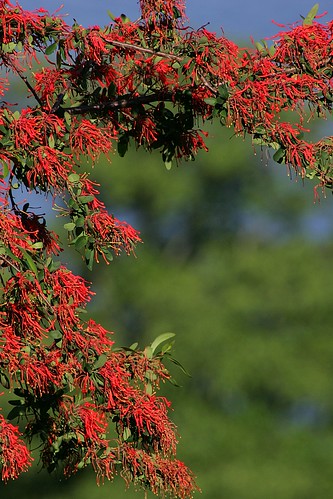
The first time I saw a hummingbird in our yard was about 3 years ago. We'd lived in our house barely a year and the Chilean fire tree in the front yard was in full bloom. It was May and the tree was ablaze with red blossoms with long slender necks grouped in tufts. I couldn't have designed a better tree for hummingbirds. You would think, looking at the tree, that it would be ablaze with hummingbirds during the near month-long bloom fest. But no, it's sadly not.

It was a fateful night. We had just come home from work and were doing some weeding in the yard when we noticed them. First one, then two or three hummingbirds began to swirl around the tree. One of us ran for the camera, another ran for a chair. We staked out the tree for hours. We sat in the front yard and answered phone calls, snapped photos, and chatted about our days while we watched the hummingbirds come and go. It was a blessed evening.

The birds came less frequently and it appeared that they had retired for the evening, so we did too. We never saw them again that year, but we were on the prowl. The next spring, we would cast an occasional glance towards the tree, hoping to see another hummingbird, but we didn't.

That fall, I decided to "set a trap." For my birthday that year, I asked for a hummingbird feeder. Certainly, they would not be able to resist a feeder! Unfortunetly, it sat in the closet for probably another year before we got the hook put in the roof to hang it outside our office window. For many months it sat there, the nectar slowly lowering but we never caught sight of the hummingbirds...until this last winter.

It was a cold and snowy winter in Seattle and my husband and I decided to work at home during the worst week of snow in December. It was so cold that the hummingbird nectar froze! To our surprise, first one hummingbird then two then three or four came to our feeder day after day. We took nearly a hundred photos, or so it seemed, of our visitors. The little splashes of color and life entertained us during those cold and lonesome days. I had no idea that hummingbirds lived in the Northwest all year long. Now I have proof!

Since those beautiful snowy days, the visits by the hummingbirds have been fewer. But today, just as the month of May and the blooms on my fire tree are winding down, the hummingbirds revealed htemselves again. It happened this evening as I was about to walk up the steps to my house from the sidewalk after work. I had been stopped by a guest of my neighbor and as we were talking I heard a commotion around the tree. I quickly turned my head into the sunlight and saw two hummingbirds dancing about. The commotion appeared to be a discussion as to which bird had rights to the tree at that moment. Before I knew it, a red headed hummingbird (Anna's, I believe) flew towards me and over my head as the winning bird began gracefully drinking from the long, thin red stems of the fire tree.

There is something so comforting in God's design. Creatures of habit, both human and bird, find comfort in the repetitiveness and cycles of this natural life. Hummingbirds on the fire tree in May bring me joy and peace because they remind me that God is good all the time and that God's faithfulness endures forever.

Tuesday, May 19, 2009

Join Other People of Faith At a Rally For Climate Protection!


By LeeAnne Beres, Executive Director

Are you looking for something new to do during your lunch break? Me too.

Luckily, the EPA is in town just in time. This week the EPA is holding two public hearings on their proposed finding that global warming pollution is a threat to human health. Two hearings in the country. One in each Washington - Seattle and Washington, DC. Seattle has the spotlight to tell our nation's leaders that it's time for immediate and comprehensive climate action. But it's going to mean you'll miss your lunch.

Earth Ministry and Washington Interfaith Power & Light have joined with a wide range of environmental organizations to turn people out for this historic event. Can you give us your noon hour to help tell the EPA to act now to stop global warming?

Please join us for a climate rally!
Thursday, May 21st at Noon Outside of Bell Harbor Convention Center 2211 Alaskan Way, Pier 66 in Seattle

Click here for more information and to RSVP: http://www.fusewashington.org/site/climate

Clergy are encouraged to wear collars, stoles, tallit, or other religious garments. If you're not clergy - wear whatever the heck you like, just be sure that you're there!

This Thursday is our chance to demonstrate decisive and overwhelming support for bold federal action on global warming. Can we count on you to rally with us? Please go to http://www.fusewashington.org/site/climate to let us know if you're able to join us.

Thanks for everything you're doing. I'll see you on Thursday!

Friday, May 15, 2009

AMEN - It’s Time to Tackle Climate Change!


By Chris Olson, Outreach Coordinator

One of my earliest memories, in fact probably the earliest memory I can recall pertaining to my understanding of environmental issues, comes from a summer evening when I was six years old. My dad owns a set of apartment buildings in my hometown and on this particular evening he was cutting the lawn with my older brother. Since I was too little to help I got to spend a few hours playing with one of my dad's renters, Willow. She was great. She was an sweet, elderly woman who always had cookies and milk for me along with a good story or two. For some reason I was watching TV with her this night. The program was about global warming, asking if it was real and, if so, what would the consequences be for the world. I vividly remember a segment about droughts, how with less rainfall forest fires would become more frequent and intense. The television screen was filled with a close up of flames from a forest fire, roaring wildly and destroying everything in its path. I was freaked out. That image left an imprint on my brain that I have never been able to wipe away. As a six year old I thought, "That's not supposed to happen! How can we let this happen?" Today, as I watch the news, read the reports, and listen to the experts telling us that climate change is real and happening and the consequences are in the here-and-now I'm still thinking, "That's not supposed to happen! How can we STILL be letting this happen?"

On Thursday, May 21st there is the chance for us to take a BIG step forward to help stop climate change. Seattle will host one of only two EPA public hearings in the entire country. The EPA is seeking public input on their decision that global warming pollution is a threat to human health, the first step in establishing new rules to reduce global warming pollution. The faith and environmental communities are stepping out in full force to call for real action to stop global warming and build a clean energy economy and we are asking YOU to join us! We’re planning a big rally outside the hearing, because it’s time for Seattle's faith community to say climate change is a moral issue and we need action now. The rally will be held at noon on Thursday, May 21st at Bell Harbor International Conference Center, Pier 66, downtown Seattle.

Please join Earth Ministry and Washington Interfaith Power & Light in speaking out for the good of all creation. We are also asking each of you to become a “Rally Magnet” and attract at least five friends to come to the Rally on May 21st. The goal is to get 3,000 people, and we’re going to need your help. Clergy, Rabbis, and other faith leaders are encouraged to wear collars, robes, and other religious garments. This event will have some fantastic speakers and will be a wonderful and memorable learning experience so feel free to bring your kids! Each act of love that we do for the Earth makes it a better place for us and future generations. We also become role models for others. Raising your voice with so many others on May 21st is one of the most important this you can do this year for the environment. For more information and to sign up for the rally follow this link or click on the Cool Crowd picture. Hope to see you there!

Monday, May 11, 2009

Life After People


By Kyoko Tsuzuki, Intern

Picking classes for Spring Quarter was a challenging process. I had two classes already, but I needed one more. As I scrolled through my options, I came across “Religion and Ecology.” It sounded interesting, so I signed up. Being a sophomore psychology major, I was not completely interested in religion or ecology, especially since I am not a huge fan of the outdoors. I am in Professor Cynthia Moe-Lobeda’s Religion and Ecology class. Professor Moe-Lobeda is a passionate woman devoted to religion and the environment. I trudged through the readings and half-heartedly sat through the lectures. I was still trying to figure out how religion and ecology could possibly be connected.

One day, my professor told me that everything in the environment is connected. At first, I was completely confused by this comment. However, after she explained it further, I understood the observation as everything in nature is reliant on something else in the environment. For instance, the plants rely on the animals and the animals rely on the plants. In order for a functional existence and habitat, one needs the other. Another addition that I picked up on during this discussion was that humans disrupted this efficient give-and-take relationship. Human beings use the environment freely and at their own will. This often comes at the expense of God's creation.

After reflecting on this sobering conclusion for several days, I saw an advertisement for a television series on the History Channel, called “Life After People.” It sounded interesting. I sat myself in front of the television for two hours to watch this program. It started out with some startling images of famous buildings overgrown with foliage and shrubbery and animals running freely on green plains.

“Life After People” gave me some hope amidst all the destruction and gloom. Perhaps humans are not completely destructive. If I learned one thing it is that humans have an important role on this planet. We are here to care for the planet and all creation. Many of our current lifestyle choices deeply impact the health of the planet, ourselves, and future generations. People need to be conscious of how they are living and try to reduce their "footprint" on the earth. This is the ultimate call of our generation.

Wednesday, May 6, 2009

Climate Action in DC - We Need Your Help Today!

What’s Happening Now

This week members of the U.S. House of Representatives are discussing the most important climate legislation in a generation, the American Clean Energy and Security Act of 2009. Earth Ministry Executive Director LeeAnne Beres is in Washington, DC now working to move this bill forward. We need your help today.

Please write or call your Representative (see http://www.house.gov/ to find yours) and urge him/her to act now to address the serious moral aspects of climate change. A contribution to Earth Ministry/Washington Interfaith Power & Light is another way of bringing the religious perspective to this debate in Congress. Our voice is vital to ensuring that the final bill has a strong cap on carbon and includes adequate funding provisions that protect poor and vulnerable populations.

Why This Bill is Important

The American Clean Energy and Security Act of 2009, also known as the ‘Clean Energy Jobs Plan’, provides an opportunity for the U.S. to take a leadership role in the urgent global effort needed to stabilize the climate. The bill includes the key ingredients necessary for a transition to a clean energy future: energy efficiency, renewable energy, modernization of the electric grid, and a cap on greenhouse gas emissions. This important legislation will also develop green jobs through a program of worker training, education, and transition to support the growth of a clean energy economy.

Our Executive Director LeeAnne is in the nation’s capital right now with 54 other religious leaders from 29 states – all calling on our elected leaders to support the American Clean Energy and Security Act. She’s there as part of the national Interfaith Power & Light network, representing you and thousands of others like you who believe that we need action on climate change now.

What You Can Do to Help

1. Contact your U.S. Representative and ask them to support the American Clean Energy and Security Act for these reasons:
  • Climate change is the most important moral issue of our time. We must love our neighbors as ourselves by protecting human communities and all of creation by passing strong climate legislation this year.
  • The Clean Energy Jobs Plan moves us closer to energy, economic, and climate security. It will reduce carbon pollution that causes global warming, break our dependence on fossil fuel, and generate millions of clean energy jobs.
  • Global warming requires a long-term moral response that embodies the hope, compassion and vision that people of faith strive to generate in our own lives and communities. The American Clean Energy and Security Act reflects these values and our elected officials should support it.

You can find your Representative and the best way to contact them through the search function on the website of the U.S. House of Representatives: http://www.house.gov/.

2. Make a donation to Earth Ministry/Washington Interfaith Power & Light to make sure your voice is heard in Washington, DC this week!

  • $15 provides an information packet on the moral dimension of climate change to an elected official
  • $30 provides that elected official with one of Earth Ministry’s creation care publications
  • $75 subsidizes the cost of meeting with one elected representative on behalf of climate protection
  • $300 covers one full day of advocating for God’s creation on Capitol Hill

You can make a secure donation online at http://www.earthministry.org/ or by calling (206) 632-2426.

Monday, May 4, 2009

Ubuntu


By Chris Olson, Outreach Coordinator

Each Lutheran Volunteer Corps house is given a name by the first group of volunteers who are placed there. The new group gets to choose the name and they often choose a word from another language with deep, cultural meaning or an influential social justice, environmental, or spiritual leader whose ideals they want to live out in their shared community. When I first received my acceptance letter to LVC, I hoped I would be placed in a brand new house so I would have the opportunity to help pick the name. I have to admit I was a little disappointed when I learned that I would living in a house that had already been established but, not only that, a house with a name that I didn't even know what it meant. Ubuntu. What?

Throughout the year, my appreciation for the concept of Ubuntu has grown to the point of seeking to embody it in everything I do. It's a traditional African philosophy which recognizes how we are inextricably bound in each other’s humanity and translates as "I am because you are". I cannot be fully myself unless you are fully yourself. Our humanity is linked and in living lives of compassion we must care for one another as we would want others to care for us. The idea struck me when I first moved into our little community, but recently it embedded itself in my mind when I was exploring the Global Oneness Project website and found a video that fully explained Ubuntu from the view of those who live it out every day as part of their culture. Please take a second to check out this clip (its worth it!)


On Saturday, May 9th, Earth Ministry is sponsoring a free Global Oneness Project event titled The New Narrative: Local Voices for a Global Future at MOHAI (Museum of History and Industry). The event will include short films from the Global Oneness Project, interactive cafe-style conversations, guest speaker Orland Bishop, and a Q&A with filmmaker Emmanuel Vaughan-Lee. For more information visit Earth Ministry's homepage.

Wednesday, April 29, 2009

It's not about doing everything, its about doing something.


By: Nicole Hobbs, Intern

As a student at Seattle University, I have had the great pleasure of taking Gary Chamberlain's class: Religion & Ecology. [Gary Chamberlain is known for his book, Troubled Waters which details the global water crisis from a theological and humanitarian perspective]. Originally, I took the class because I thought it would be an easy A--write a few papers, volunteer a few hours, and take a few tests. Wow--was I wrong. Over the past five weeks, I have realized that this class is going to be one of my toughest yet (and I'm in my senior year) because of the sheer impact it has had on my thoughts, practicies, and beliefs. Sustainability and saving the environment is not just about recycling my bottles and taking the bus, instead it is about cherishing the interconnectedness of the planet God has given us.

We recently had Dr. Sallie McFague spend the morning with our class. Dr. McFague is "widely recognized as one of North America’s preeminent feminist theologians and eco-theologians" and her newest book is titled: A New Climate for Theology: God, the World, and Climate Change.

Dr. McFague grew up during the Great Depression, and she fell in love with nature from an early age. Her parents had a one room cabin the the woods and would often take their children there to introduce them to nature. Sallie then mentioned that she was worried that parents and children today just don't do the same thing. Instead we are attached to video games, the internet, and television. This shift from enjoying the natural gifts of the world to the technological creations of our society--is one of the reasons Sallie gives for humanities lack of concern from the planet. She told us that if children and parents could once again see the gifts of nature, the gifts from God then they would feel sad watching the natural world disappear and would shift their actions to help protect it. It is sad when I think of my own childhood, void of natural experiences, and I realize what Sallie is saying is true.

The second story that I can share is from when Sallie was ten years old. Dr. McFague knew from a young age that she wanted to be a pilot in the Navy. Now, at the time, women were not allowed to be pilots and this troubled her. She said that she just knew in her heart that this was wrong, and she knew that she would one day change this and become a pilot. The moral of her story is this: if enough people stand up and say no (and have that instinct that something is wrong) then thats how we will see environmental change. Now, being a bunch of college students we were quick to challenge her.

We expressed how overwhelming the problems facing our environment are and we challenged her to give us a more detailed solution to the problem. What could we actually do?! She smiled and simply said: its not about doing everything, instead its about doing something and doing what you are good at. You don't need to become a staff member of Earth Ministry to change the world, instead use your own passions and talents (whether they be in marketing, accounting, or sports) to change the world around you.

Its okay to do something small because in this large connected world it adds up.

Wednesday, April 22, 2009

Our Second Annual St. Francis Sermon Contest

Call for Submissions!

Earth Ministry is now accepting entries
for our Second Annual
St. Francis Creation Care Sermon Contest

Throughout the world, the Holy Spirit is actively calling individuals and congregations to care for all of God's creation. Earth Ministry's St. Francis Creation Care Sermon Contest seeks to call out the voice of the spirit moving in our midst. If you have a message of faith, hope, or action for our Earth that you long to share with the greater community, we invite you to enter the sermon contest so that others might be inspired.

The contest is open to anyone and everyone who wants to submit a sermon, homily, or message related to care for God’s creation. Four finalists will be selected to give their sermons at Earth Ministry’s Celebration of St. Francis on September 26, 2009. Contestants must be members of Earth Ministry. Become a member today!


See our website for full contest rules and fabulous prizes.

Monday, April 20, 2009

Bring What I Am Able


Chris Olson, Outreach Coordinator

Recently I've been reminiscing. As I reach the final 3 1/2 months my Lutheran Volunteer Corps year I am beginning to seriously consider what comes next. At times its seriously fun to consider all the options and at other times its seriously scary. Over the past few weeks I've experienced a number of coincidences that have allowed me to reminisce back to the time when I was considering applying for LVC. This year has granted me such an amazing space to explore myself, gain a new understanding of social justice and simplicity, and try new ways of living that's its a curious experience to reflect backwards. Thinking about where and who I was then and where and who I am now. Still the same, yet transformed as well.

The reflection leads to questions. Where do I go from here? What new changes and challenges will I face and how will they shape me? Where is God at work in my life right now and where am I being led? As I step out of my LVC community, how do I integrate all that I've learned into the "real world?" Now that I am so aware of the incredible injustices surrounding me, how do I live my life so that I am fighting those injustices and making the world a better place for all of creation?

While I was thinking about things from my past that helped lead me to where I am today I remembered one of my favorite songs/music videos that I was fairly obsessed with a couple years ago. The song is "World On Fire" by Sarah McLachlan. She chose to spend her $150,000 dollars slotted for a flashy, Hollywood music video instead on charities around the world which improve the lives of and empower marginalized groups of people. The video depicts what the money was budgeted for and where it went instead (Example: $5000 = cost of hair and makeup for one day but instead paid for one years schooling for 145 girls in Afghanistan).


The chorus is:

The world is on fire
It's more than I can handle
I'll tap into the water
Try and bring my share
Try to bring more, more than I can handle
Bring it to the table
Bring what I am able ...

As I think about where I was two years ago, where I am today, and where I am being led I can't help but be reassured that no matter how confusing or exciting or scary it may get...the best I can do, any of us can do, is bring what we are able. I am who I am and have been uniquely gifted and blessed and the most I can hope for is that I am giving the best of myself in whatever I do and with whoever I am spending time. We may not have $150,000 to give but we can let our love rain down over all of God's people and creatures and creations. That is why we are here. I may not always remember that as I get caught up in the rush of the next few months but maybe at this time next April, wherever I am, I will remember back to today, watch "World On Fire" for the umpteenth time, and recommit to bringing what I am able all over again.